TENS OF THOUSANDS DISPLACED AS 'BASYANG' BATTERS PHILIPPINES
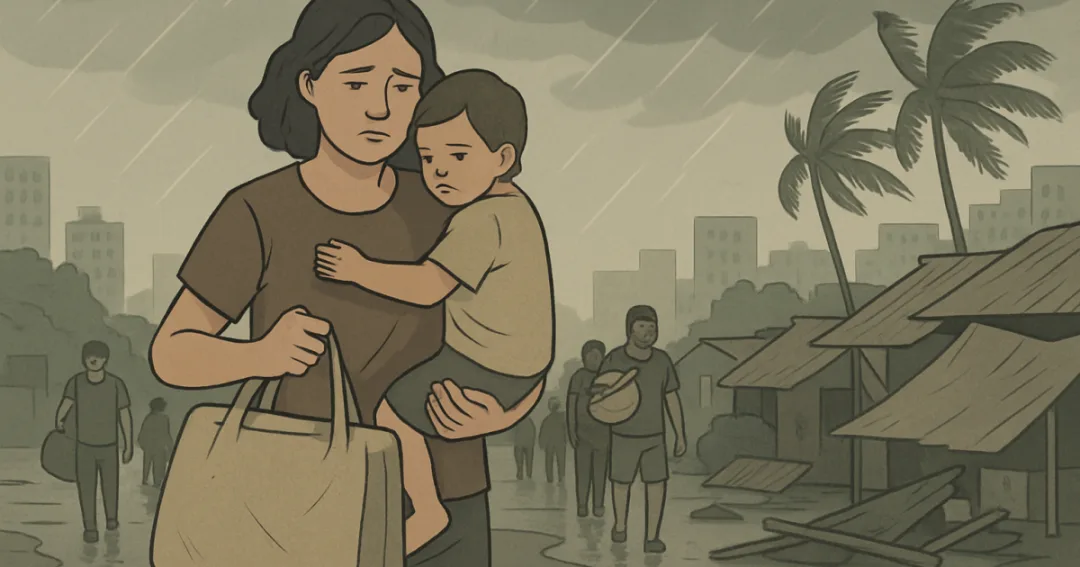
Tropical Storm “Basyang” has once again exposed the Philippines’ deep vulnerability to extreme weather, as tens of thousands of residents have been forced from their homes by flooding, landslides, and storm surges. Behind the headline figures are families carrying their belongings through waist-deep water, children sleeping in crowded evacuation centers, and livelihoods interrupted with no clear timeline for recovery. Displacement on this scale is not only a humanitarian concern; it is a stress test for local governance, basic services, and social cohesion. When communities must move abruptly, even temporarily, the disruption affects schooling, health care, and economic activity. Each new storm therefore becomes not just a meteorological event, but a measure of how prepared the country truly is to withstand and recover from climate-related shocks.
The Philippines is no stranger to such storms, sitting as it does in a region frequently visited by tropical cyclones. Over the years, the country has experienced a succession of damaging weather systems that have left scars on infrastructure and public memory alike. This historical pattern has prompted repeated calls for better disaster risk reduction, improved early warning systems, and more resilient urban and rural planning. Yet the recurring scenes of mass evacuation and widespread displacement suggest that implementation still lags behind policy ambition. The cycle of response, relief, and rebuilding continues, often without sufficient time or resources to address the underlying vulnerabilities exposed by each storm.
The displacement caused by “Basyang” also underlines the unequal burden of climate risk. Those living in informal settlements, low-lying coastal areas, or mountainous regions prone to landslides are often the first to evacuate and the last to recover. Many depend on daily wages, small-scale farming, or fishing, making even short-term disruption potentially devastating to household income. When shelters are crowded and basic facilities are strained, the risk of disease, malnutrition, and psychological stress grows, especially for children and the elderly. These are not abstract concerns; they shape how quickly a community can return to normal life, and whether people can maintain trust in public institutions during and after a crisis.
Institutional responses to such disasters typically involve a familiar sequence: warnings, evacuations, relief distribution, and gradual return or resettlement. The effectiveness of each step depends on coordination across agencies, clarity of communication, and the capacity of local governments to act swiftly. In recent years, there has been more emphasis on pre-disaster planning, community drills, and the use of technology for monitoring and alerts. Still, the recurring displacement caused by storms like “Basyang” suggests that resilience must be understood not only as physical infrastructure, but also as social and economic security. Long-term solutions will require sustained investment in safer housing, diversified livelihoods, and environmental protection to reduce the impact of floods and landslides.
As the climate crisis intensifies, storms of “Basyang’s” kind are likely to test the Philippines with increasing frequency and complexity. The current displacement should be seen not only as an emergency to be managed, but as evidence in an ongoing national conversation about development, land use, and climate adaptation. Decisions made now—about where people can safely live, how cities expand, and how ecosystems are protected—will determine whether future storms displace tens of thousands, or far fewer. Ultimately, the measure of progress will not be the speed with which tarpaulins and relief packs arrive, but the degree to which fewer families need them at all.